Intention
What I planned to do.
A synchronized behavioral portrait comparing what I intended to do, what my digital avatar actually did, and how my body unconsciously responded.
Play, pause, scrub, or inspect 15 / 38 / 60 seconds.
The visualization does not score the player or explain behavior psychologically. It compares three temporal accounts of one gaming session: the route I intended to follow, the actions performed by my digital avatar, and the changing posture of my physical body. Their agreements and mismatches accumulate into one behavioral trace.
What I planned to do.
What the avatar actually did.
How the body responded.
The digital and physical workbooks were recorded independently. Physical 00:04 and digital 00:18 are aligned as the same real-world moment, then every state and event is reconstructed inside its own temporal channel.
Chapter markers carried to timed digital rows.
Planned, detour, and an explicit initial unknown state.
Seven avatar behaviors sustained until the next action change.
Six body states parsed independently from gesture timestamps.
Instantaneous physical events with no invented duration.
Collect and explore remain point events on the actual route.
The original sheets mix sustained states with instantaneous events, and every duration cell is blank. A gesture timestamp cannot be paired with a posture merely because they share a spreadsheet row. Each channel is therefore parsed, sorted, aligned, and validated independently before visualization.
Mixed temporal grains and inconsistent timestamp formats.
Independent channels, endpoint assumptions, and interpretation limits.
Aligned seconds, duration, source rows, and validation status.
Six reconciled p5-friendly collections with unchanged sources.
A proportional 2,996-to-60-second transformation.
The system behaves like an instrument rather than a literal game map. Time controls horizontal position; category, duration, posture, and event type control the visual properties around that shared route.
The uninterrupted expected route.
Leaves and reconnects during six recorded detours.
Duration sets dot count; timestamp fixes route position.
Posture changes scale, eccentricity, opacity, and pulse rate.
A short ripple leaves one permanent notch in the route.
Point events and duration-proportional journey sections.
Previously emitted dots keep deterministic positions while later events accumulate. At 59.02 seconds the digital route stops; the body continues through the final physical aftertrace.
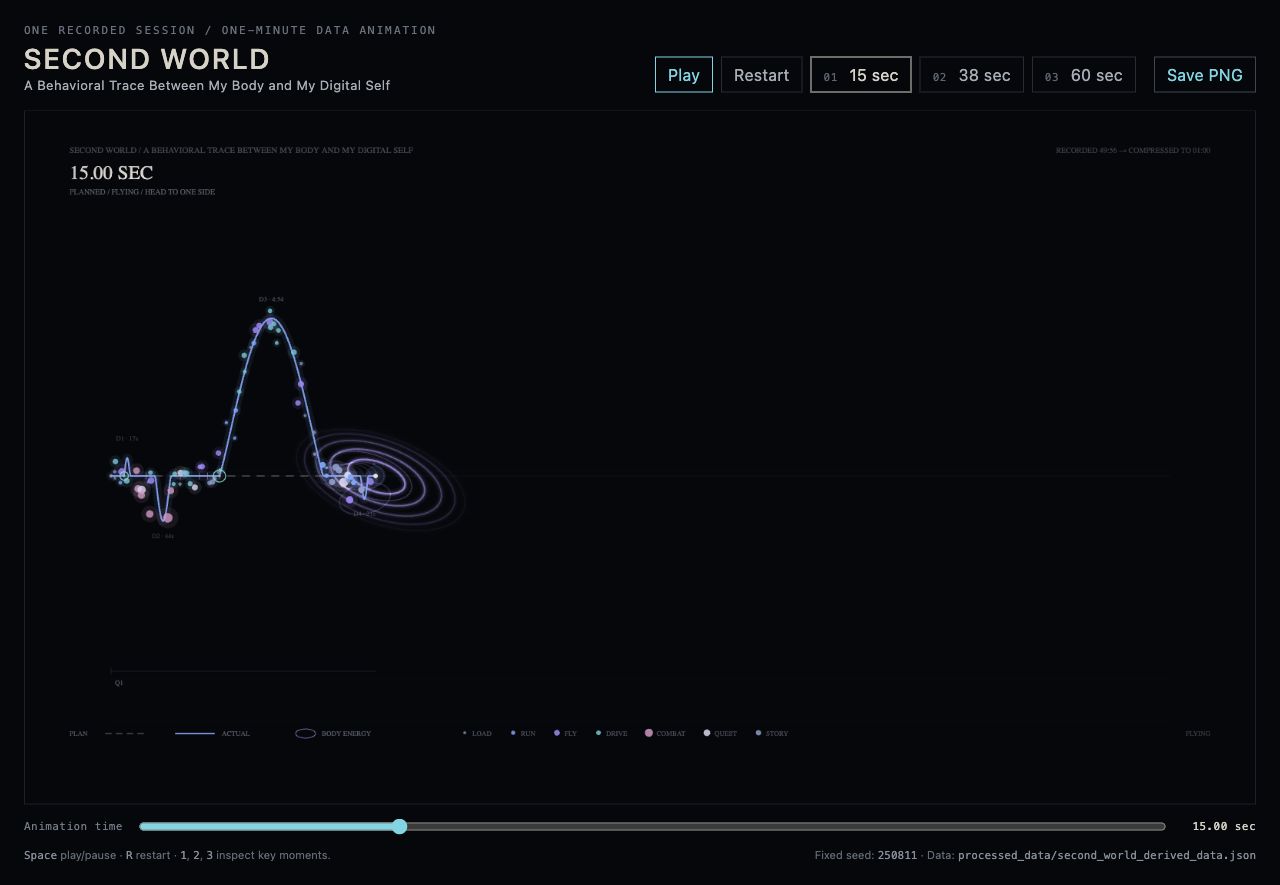
Quest 1’s dominant detour establishes the difference between plan and behavior.
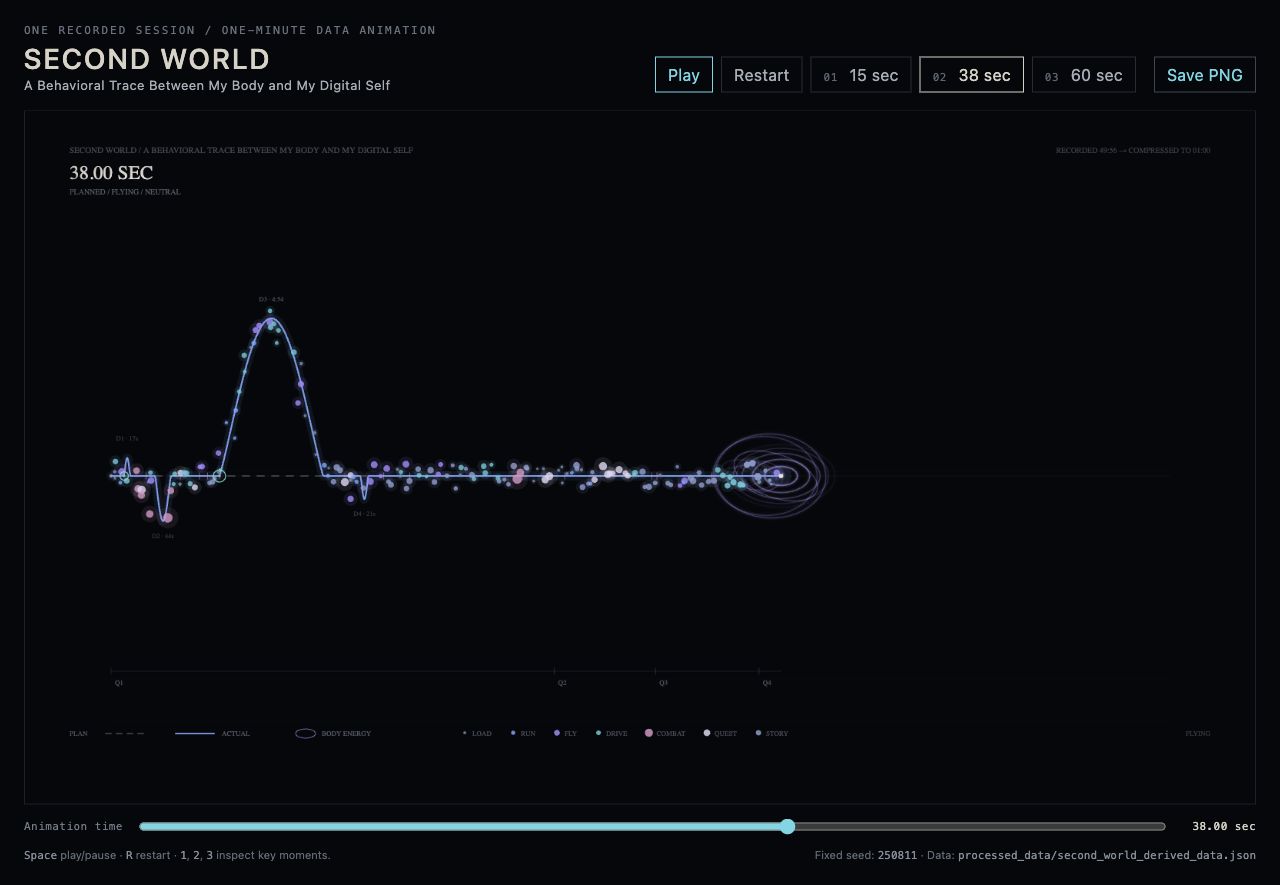
Multiple quest sections and action rhythms accumulate without resetting the frame.
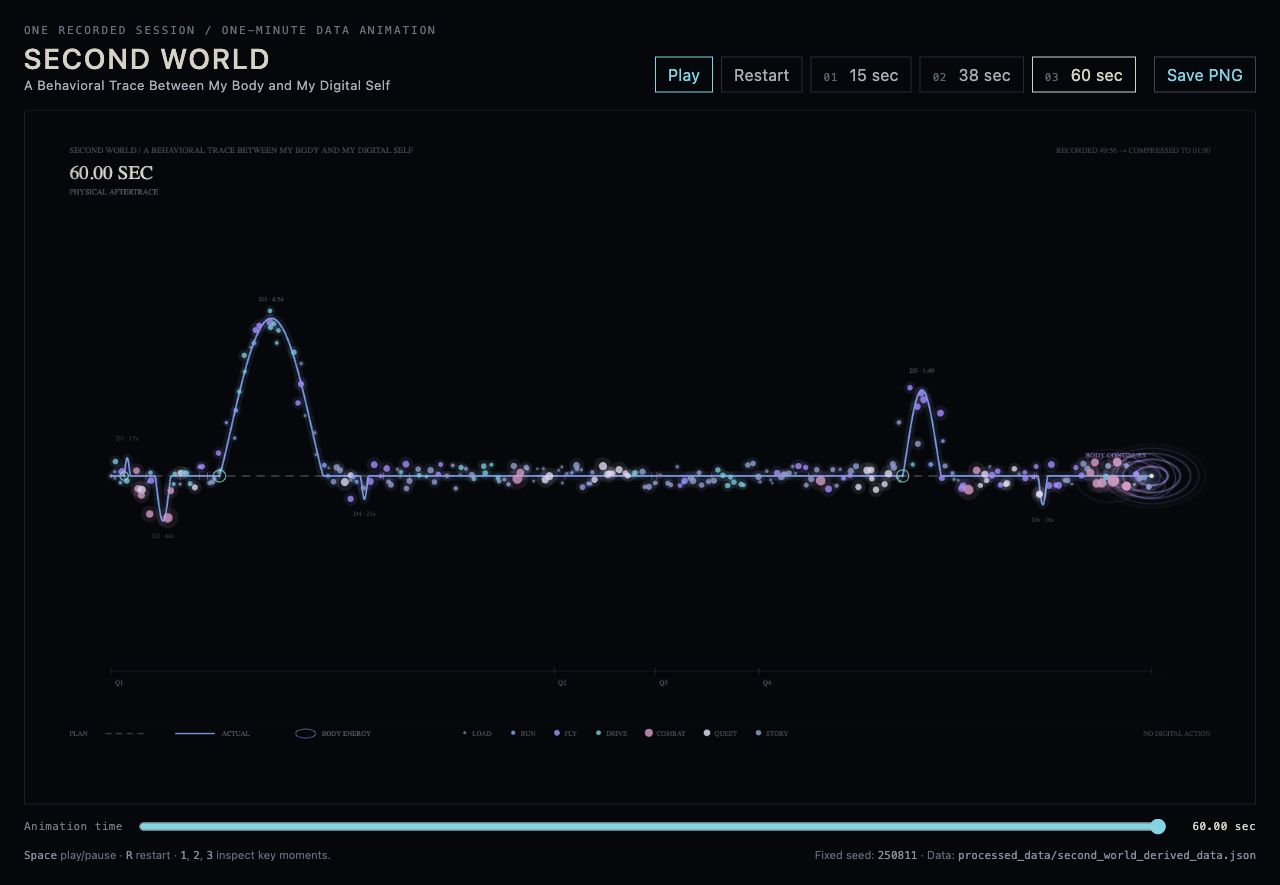
The completed trace remains alive through an autonomous physical ripple.
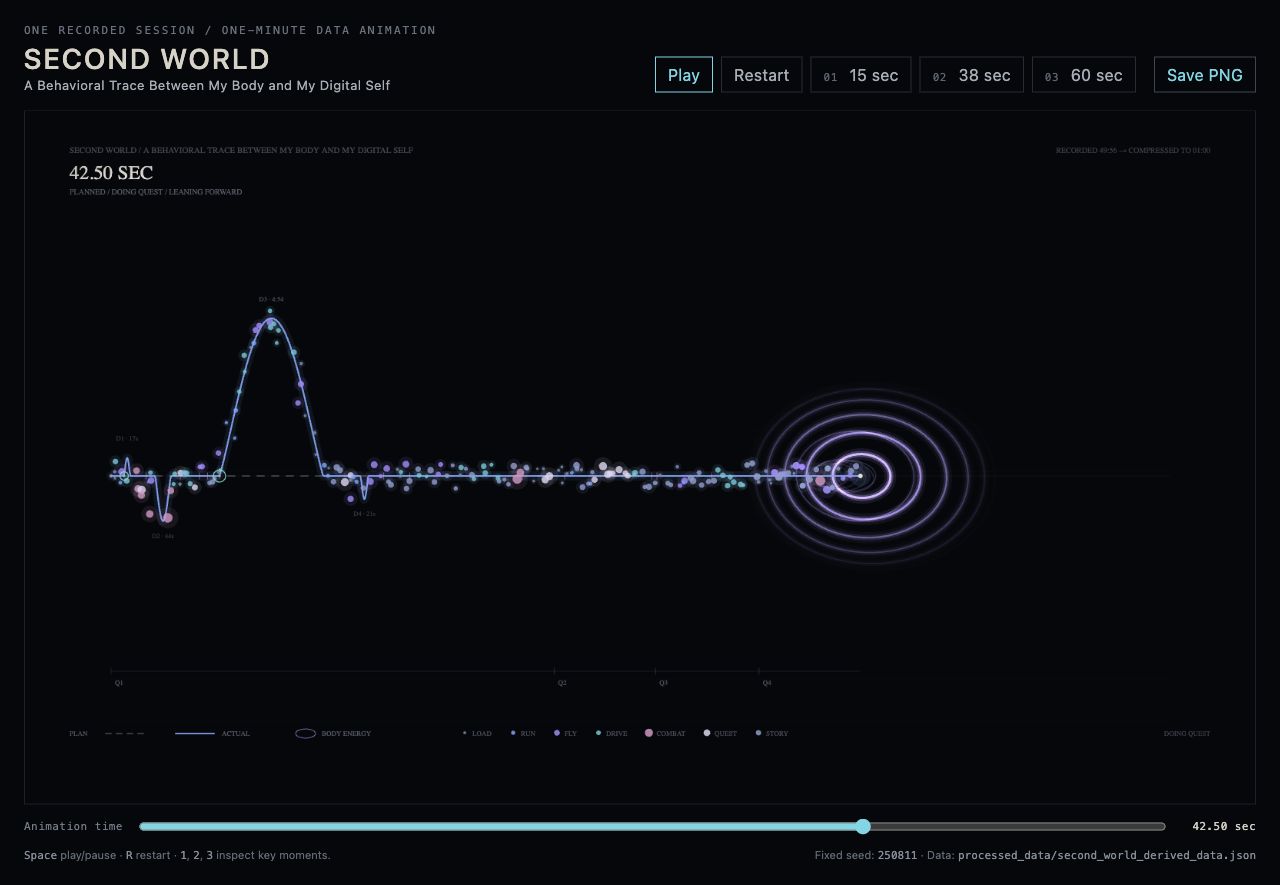
The strongest recorded body state expands and brightens the physical-energy field without reclassifying the digital action.
The complete session answers when physical and digital states overlap. Three completed quest portraits compare duration, detour share, action rhythm, and bodily response. Hovering a portrait opens a fixed 120-second detail window with its own moving playhead.
30.0% detour
0% detour · original Q2 + Q3
12.1% detour · original Q4
The project preserves the limits of the recording instead of converting them into confident-looking graphics. Every derived record retains its source row, raw timestamp, and assumption flags.
The final animation makes three temporal selves visible without collapsing them into one measure of intensity. Intention supplies a reference, digital action builds behavioral matter, and the physical body changes pressure and depth. Their mismatches are not errors to correct; they are the subject of the work.